606. Construct String from Binary Tree
Problem Description
Given the root of a binary tree, construct a string consisting of parenthesis and integers from a binary tree with the preorder traversal way, and return it.
Omit all the empty parenthesis pairs that do not affect the one-to-one mapping relationship between the string and the original binary tree.
Example 1:
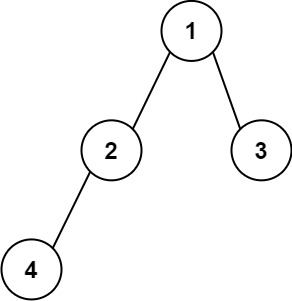
Input: root = [1,2,3,4]
Output: "1(2(4))(3)"
Explanation: Originally, it needs to be "1(2(4)())(3()())", but you need to omit all the unnecessary empty parenthesis pairs. And it will be "1(2(4))(3)"
Example 2:
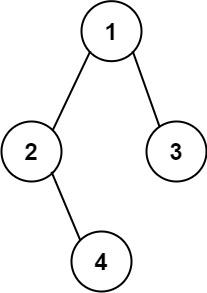
Input: root = [1,2,3,null,4]
Output: "1(2()(4))(3)"
Explanation: Almost the same as the first example, except we cannot omit the first parenthesis pair to break the one-to-one mapping relationship between the input and the output.
Constraints:
- The number of nodes in the tree is in the range
[1, 104] -1000 <= Node.val <= 1000
Solution
Python Solution
class Solution:
    def tree2str(self, root: Optional[TreeNode]) -> str:
        if not root:
            return ""

        result = str(root.val)

        if root.left or root.right:
            result += "(" + self.tree2str(root.left) + ")"

        if root.right:
            result += "(" + self.tree2str(root.right) + ")"

        return result
Time Complexity: O(n)
Where n is the number of nodes in the binary tree.
Space Complexity: O(h)
Where h is the height of the tree for recursion stack.
Java Solution
class Solution {
    public String tree2str(TreeNode root) {
        if (root == null) {
            return "";
        }

        StringBuilder result = new StringBuilder();
        result.append(root.val);

        if (root.left != null || root.right != null) {
            result.append("(").append(tree2str(root.left)).append(")");
        }

        if (root.right != null) {
            result.append("(").append(tree2str(root.right)).append(")");
        }

        return result.toString();
    }
}
Time Complexity: O(n)
Where n is the number of nodes in the binary tree.
Space Complexity: O(h)
Where h is the height of the tree for recursion stack.
C++ Solution
class Solution {
public:
    string tree2str(TreeNode* root) {
        if (!root) {
            return "";
        }

        string result = to_string(root->val);

        if (root->left || root->right) {
            result += "(" + tree2str(root->left) + ")";
        }

        if (root->right) {
            result += "(" + tree2str(root->right) + ")";
        }

        return result;
    }
};
Time Complexity: O(n)
Where n is the number of nodes in the binary tree.
Space Complexity: O(h)
Where h is the height of the tree for recursion stack.
JavaScript Solution
/**
 * @param {TreeNode} root
 * @return {string}
 */
var tree2str = function(root) {
    if (!root) {
        return "";
    }

    let result = root.val.toString();

    if (root.left || root.right) {
        result += "(" + tree2str(root.left) + ")";
    }

    if (root.right) {
        result += "(" + tree2str(root.right) + ")";
    }

    return result;
};
Time Complexity: O(n)
Where n is the number of nodes in the binary tree.
Space Complexity: O(h)
Where h is the height of the tree for recursion stack.
C# Solution
public class Solution {
    public string Tree2str(TreeNode root) {
        if (root == null) {
            return "";
        }

        StringBuilder result = new StringBuilder();
        result.Append(root.val);

        if (root.left != null || root.right != null) {
            result.Append("(").Append(Tree2str(root.left)).Append(")");
        }

        if (root.right != null) {
            result.Append("(").Append(Tree2str(root.right)).Append(")");
        }

        return result.ToString();
    }
}
Time Complexity: O(n)
Where n is the number of nodes in the binary tree.
Space Complexity: O(h)
Where h is the height of the tree for recursion stack.
Approach Explanation
The solution uses recursive preorder traversal:
- Key Insights:
- Preorder traversal
- Parenthesis handling
- Empty node omission
- String building
- Algorithm Steps:
- Process root
- Handle left subtree
- Handle right subtree
- Build result
Implementation Details:
- Recursive approach
- String concatenation
- Null checks
- Parenthesis rules
Optimization Insights:
- StringBuilder usage
- Early termination
- Minimal parentheses
- Memory efficiency
Edge Cases:
- Empty tree
- Single node
- Left-only tree
- Right-only tree